
Exploring the Best Dublin Traditional Pubs for 2026
Dublin has roughly 750 licensed pubs inside the M50 ring road, but fewer than 30 still preserve the Victorian snugs, mahogany counters, and session traditions that define a genuinely traditional Irish pub. This 2026 guide skips the Temple Bar crush and walks you through the named houses locals actually drink in — from The Brazen Head on Bridge Street (licensed since 1198) to John Kavanagh's "The Gravediggers" beside Glasnevin Cemetery, where barmen still refuse to serve food, play music, or hang a television.
Each pub below includes the address, why it qualifies as traditional, and a specific local tip — when to arrive for a snug, which night has a real trad session, and how to spot a properly pulled Guinness. The focus is 12 historic houses, plus a pragmatic section on pub etiquette, Guinness quality cues, and the "why Temple Bar is fine for 30 minutes" question every first-time visitor asks. Pints in 2026 run €6.80 to €8.50 in the city centre, with the best value three tram stops out from the main squares.
The History of Dublin's Oldest Pubs
Dublin's pub tradition is structurally older than most European capitals realise. A licensed premises has stood on the Brazen Head site at 20 Bridge Street Lower since 1198, predating Trinity College by almost 400 years. The Intoxicating Liquor Act of 1927 and the Vintners Federation rules that followed froze many interiors in place, which is why you can still see brass taps, etched mirrors, and gas-lamp mountings from the 1870s inside pubs like The Long Hall and Ryan's of Parkgate Street.
Victorian publicans were often grocers, undertakers, and moneylenders under the same roof — Kavanagh's "The Gravediggers" kept that exact configuration until the 1970s, which is why the front bar has no music and no television: it was a house of quiet business, not entertainment. Many traditional houses also kept private "snugs," tiny frosted-glass booths near the front door where women, clergy, and Garda could drink privately. You'll still find original snugs at the best pubs in Dublin including Toners on Baggot Street (widely regarded as the finest surviving example) and The Stag's Head on Dame Court.
The 2004 smoking ban — Ireland was the first country in the world to enforce it in pubs — paradoxically helped preserve traditional interiors. Pubs that had been nicotine-stained for a century were forced to clean and repaint, revealing original Edwardian tilework and plaster ceilings that modern owners now protect as heritage assets. When you walk into Grogan's on South William Street or The Palace Bar on Fleet Street, the nicotine-free smell of wood polish and stout is the direct result of that 2004 law.
The Brazen Head — 20 Bridge Street Lower
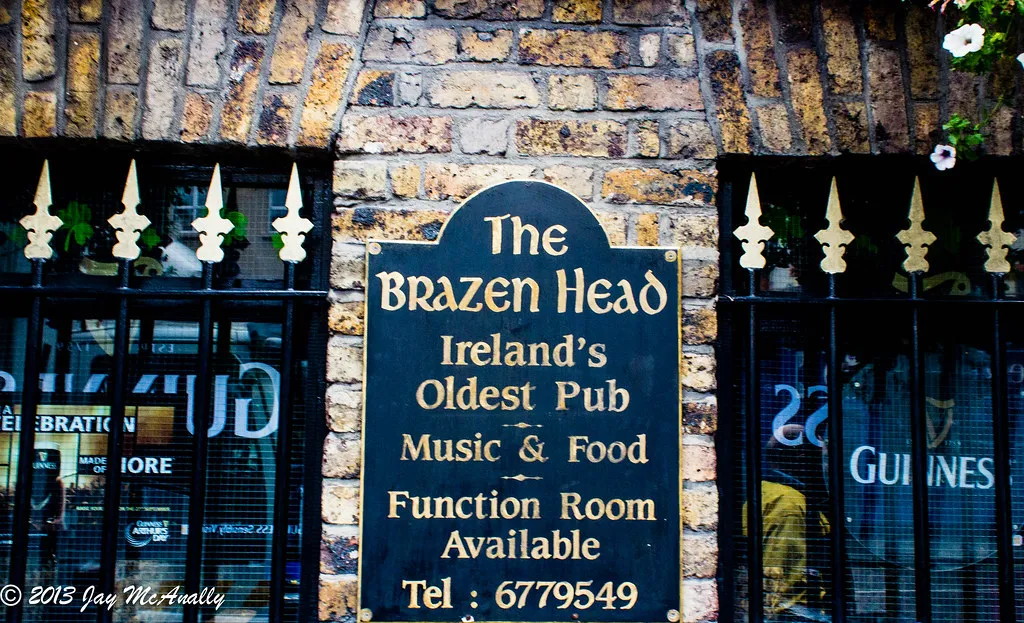
The Brazen Head is the oldest continuously licensed pub in Ireland, with a drinking house on this spot since 1198 and the current building dating from 1754. It sits a 9-minute walk west of Temple Bar, across the Liffey from the Four Courts, and the cobblestone courtyard out front is a good marker — if there's no courtyard, you're at the wrong address. Expect €8.00 for a pint of Guinness in 2026 and €16 to €22 for pub mains like beef and Guinness stew. Arrive before 18:00 weekdays to claim the dark-timber back room where Wolfe Tone and Robert Emmet plotted the 1798 rebellion. The nightly "Irish Folklore Evening" dinner show runs €65 with booking required via brazenhead.com — touristy, but genuinely earns the visit for first-timers.
The Long Hall — 51 South Great George's Street
The Long Hall is Victorian Dublin in amber. The 1881 interior has crystal chandeliers, red-leather banquettes, a gilt-framed back bar, and an intact carved mahogany counter that runs almost the full length of the room. It's deliberately small — capacity is under 80 — so arrive by 17:30 on a Friday or 19:00 on a Tuesday to get a seat. George's Street is 8 minutes south of Temple Bar on foot but feels like a different city. The Long Hall serves no food, which keeps the focus on the pint and the conversation; staff wear white jackets and will not rush a two-part pour. Most nights the clientele is 80% Dublin regulars.
The Stag's Head — 1 Dame Court
Tucked up a small alley off Dame Street, The Stag's Head has the most photographed Victorian interior in Dublin: stained glass windows depicting pub scenes (not religious ones), a granite bar, carved wooden stag heads, and the mirrored "Monaco" back bar. The building dates from 1770, the current interior from 1895, and it was the first Dublin pub wired for electric light. The ground-floor bar is packed by 20:00 Thursday through Saturday — most visitors miss the upstairs lounge, which has its own bar, a weekly Tuesday ukulele jam at 20:30, and far better odds of a seat. The pub serves Guinness and oysters as a traditional pairing (€14 for six), a combination that sounds unlikely until the first bite.
The Palace Bar — 21 Fleet Street
The Palace Bar is the authentic exit ramp from Temple Bar. It sits literally on Fleet Street at the northern edge of the Temple Bar precinct, a 90-second walk from Temple Bar Square, but the crowd is completely different — mostly Irish, many journalists from the nearby Irish Times building, and a steady clientele of Abbey Theatre regulars. The front bar (1823) is standing-room small; the real destination is the "jewel box" back room with its stained-glass skylight, which was a private literary salon for Flann O'Brien, Patrick Kavanagh, and Brendan Behan in the 1940s. The Palace stocks over 200 Irish whiskeys including the house-bonded Palace Bar Fourth Estate Single Malt (around €16 a measure).
O'Donoghue's — 15 Merrion Row
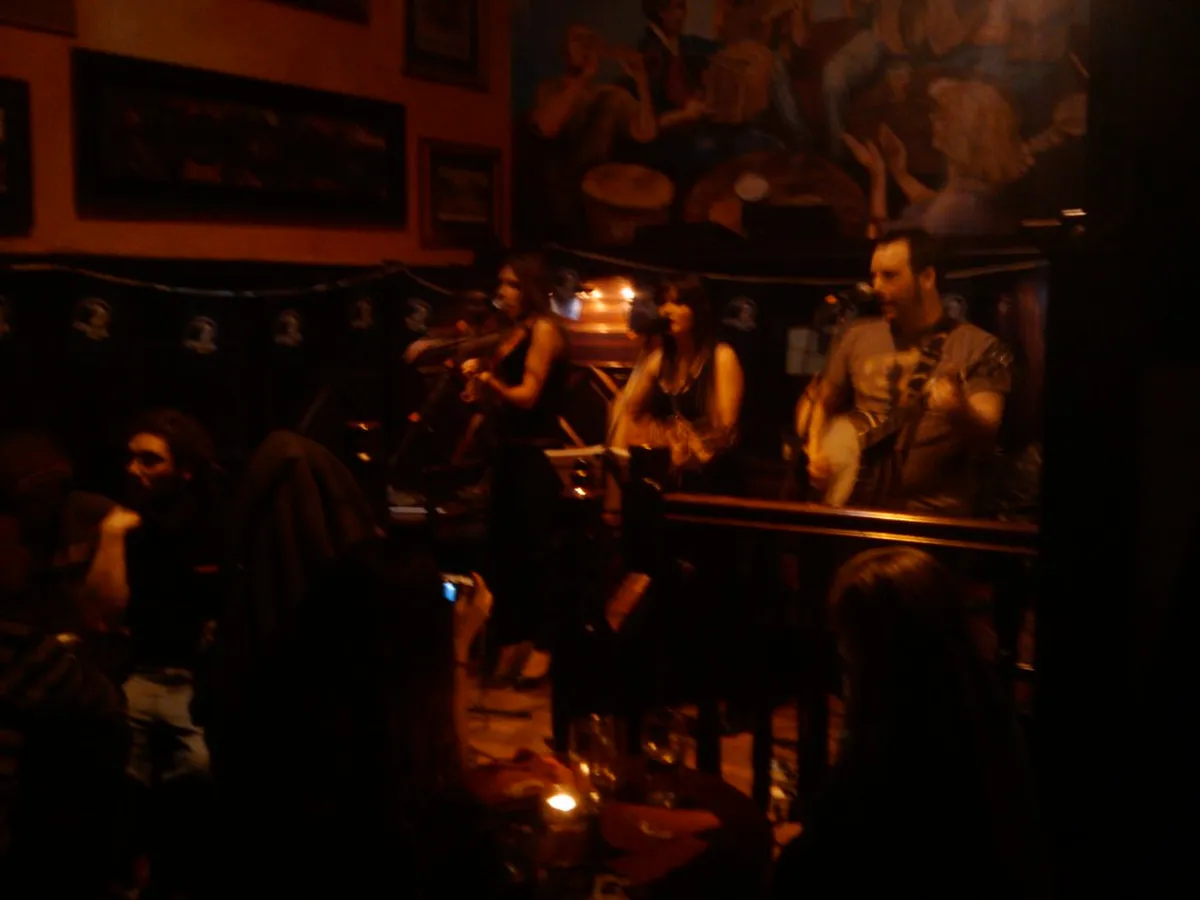
O'Donoghue's is the answer to "where do I hear proper traditional Irish music tonight?" It's a block off St Stephen's Green, open since 1789, and the pub where The Dubliners formed in 1962. Live trad sessions run every night from around 21:30 — fiddles, bodhráns, tin whistles, uilleann pipes, and sometimes a concertina — with afternoon sessions Saturday and Sunday from 16:00. There is no cover charge, no stage, and no microphone: musicians sit around a table along the left wall and play until they feel like stopping. Arrive by 20:30, order a pint (€7.50 in 2026), and stand against the wall — do not talk loudly over the musicians or request songs unless the lead player makes eye contact with you first.
The Cobblestone — 77 North King Street, Smithfield
The Cobblestone is the session pub that serious trad musicians treat as a spiritual home. It's a ten-minute walk north of the Four Courts in the Smithfield area, easiest reached by Luas Red Line to Smithfield stop (two tram stops from Jervis). The front bar is tiny, the pints are well-kept, and the listening room at the back — entered through a side door — hosts nightly curated sessions run by the Mulligan family, who own the pub and are themselves musicians. You are expected to stop talking when a musician starts a tune; regulars enforce this. Best nights are Monday (Balaclava session, 19:30), Wednesday (Night Before Larry Got Stretched singing session, 21:30), and Friday walk-up sessions after 21:00. A planned 2021 redevelopment was blocked by a 10,000-strong protest; the pub is now on Dublin's protected structures register.
Toners — 139 Lower Baggot Street
Toners licensed in 1818 and looks largely unchanged since the 1890s — dark wood, gas-lamp mountings (now electric), wooden drawers behind the bar that once held tea and grocery stock from its spirit-grocer days. W.B. Yeats famously drank here once, declared he had "seen a pub" and left, a story the staff still tell with a straight face. The snug at the front right is considered the finest surviving snug in Dublin — an enclosed booth with a service hatch, frosted glass, and a brass bell to call the barman. Arrive before 18:00 to claim it on a weeknight; it seats four comfortably. The heated, covered back garden (Toner's Yard) makes this one of the few historic pubs that works year-round for larger groups, and local drinkers reliably place its Guinness in the city's top three.
McDaid's — 3 Harry Street
McDaid's is the Brendan Behan pub. The Irish author used Harry Street, off Grafton, as his second office in the 1950s, and the ground-floor bar still has the high narrow proportions of the 19th-century city mortuary it once was before becoming a pub. Patrick Kavanagh, Flann O'Brien, and J.P. Donleavy all drank here during the mid-century Dublin literary scene known as the "Catacombs" set. It's a cramped bar with a tiny upstairs snug — get the corner table near the window for the best people-watching on Harry Street. Pints are €7.20, no food beyond crisps and peanuts, and the conversation runs bookish. A drinker's pub, not a food pub.
Davy Byrnes — 21 Duke Street
Davy Byrnes is the "moral pub" Leopold Bloom visits in James Joyce's Ulysses — Chapter 8, 13:00 on 16 June 1904, where Bloom orders a gorgonzola sandwich and a glass of burgundy. That exact sandwich and that exact glass are still on the menu (€14.50) and are the traditional lunch for Bloomsday every 16 June, when costumed readers fill Duke Street. The Art Deco interior dates from a 1942 refurbishment, which makes it less Victorian than the other pubs on this list but no less historic. It functions today as a respectable gastropub with Dublin Bay seafood and oysters — the only pub in this guide where you can reliably book a table online. A pint is €7.80.
John Kavanagh's "The Gravediggers" — 1 Prospect Square, Glasnevin
John Kavanagh's is in the seventh generation of family ownership, trading since 1833, and sits directly against the back wall of Glasnevin Cemetery — which is how it earned the "Gravediggers" nickname. The front bar has no music, no television, no Wi-Fi, no menus, and no credit card reader at the main counter (some tables now take card, but cash is expected at the bar). This is deliberate preservation, not neglect: the family has refused renovation offers for over a century. Get here by Dublin Bus 140 from O'Connell Street (about 20 minutes) or a €15 taxi. The newer lounge on the right serves excellent tapas (scallop-and-black-pudding is €9.50) added in 2011. Gravediggers is the single most cited pub in Dublin for Guinness quality — the pub every Dublin taxi driver will name when asked where they drink.
The Celt — 81 Talbot Street
The Celt is on the Northside between O'Connell Street and Connolly Station — a 6-minute walk from O'Connell Bridge — and it's the pub to visit for a proper local trad session without the Cobblestone's crowd-management. The front bar is small and cottage-like; the back hall opens into a cavernous room covered in Irish memorabilia, GAA jerseys, and faded photographs. Nightly trad sessions run from 21:30, with singing sessions on Monday and fiddle-led groups mid-week. Pints are €6.80 (the lower end of city-centre pricing), and pub food like Irish stew, seafood chowder, and bacon and cabbage runs under €18. A good stop on the way back from the Guinness Storehouse if you're taking Luas Red Line to Connolly.
Mulligan's — 8 Poolbeg Street
Mulligan's is the Dublin journalism pub — licensed in 1782, a two-minute walk from Trinity College and three minutes from the old Irish Press building. John F. Kennedy drank here as a Trinity student in 1945, and the back bar still looks like a 19th-century commercial traveller's dining room. The place is famously utilitarian: no carpet, wooden benches, smoke-stained (pre-2004) ceiling, and staff who will serve you quickly and then leave you alone. Mulligan's is widely cited alongside The Gravediggers and Toners as pouring a top-three Guinness in the city. A pint is €6.90, among the lowest in the centre. This is not a tourist pub and does not advertise.
The Perfect Pint of Guinness: What to Look For
A proper Dublin Guinness is a two-part pour that takes between 119.5 and 125 seconds — the official Diageo instruction is 119.5, and serious pubs follow it. Stage one fills the glass to 75% on the angled pour, then rests while the nitrogen cascades downward; stage two tops it off with a convex dome rising just above the rim. If the bartender hands you a finished pint in under 90 seconds, it was rushed and the head will collapse within a minute.
Four visible quality cues tell you whether the pint is right before you taste it. First, the head should be roughly 15 millimetres thick — about the width of a one-euro coin. Second, the dome should stand convex, not flat or concave. Third, the body should be deep ruby-black when held to light, not brown. Fourth, the glass itself should be presented with the harp logo facing you — the traditional Guinness courtesy cue. The best-poured pints in Dublin are consistently at Kavanagh's "The Gravediggers" in Glasnevin, Mulligan's on Poolbeg Street, and Toners on Baggot Street, mainly because those three pubs turn over enough stout to keep their lines clean daily.
Serving temperature matters too: Guinness is pulled at 6 to 8 degrees Celsius, which is colder than British bitter but warmer than lager. If the pint feels ice-cold on the first sip, the cellar is too cold and the flavour will be muted. A slightly cool, creamy mouthfeel with a dry barley finish is the target. You can tour the Guinness Storehouse to see the brewing process, but for the pint itself, trust a high-turnover local house.
Literary Pubs: Joyce, Behan, Kavanagh, and Yeats
Dublin's Nobel Prize count — four for literature (Yeats, Shaw, Beckett, Heaney) — is inseparable from its pub culture. James Joyce mapped 16 June 1904 across Dublin's pubs in Ulysses, and a DIY Bloomsday pilgrimage in the correct order reads: The Brazen Head, then Davy Byrnes for the gorgonzola sandwich, then Ormond Hotel Bar (Chapter 11), finishing at Mooney's (now gone). Joyce's exile notwithstanding, the pubs are still there and still readable from the text.
Brendan Behan's circle drank at McDaid's on Harry Street and The Palace Bar on Fleet Street. Patrick Kavanagh, the poet of Raglan Road, held court at The Palace Bar and later at Grogan's on South William Street. W.B. Yeats was a reluctant pub-goer but drank exclusively at Toners when pressed. The Dublin Literary Pub Crawl (dublinpubcrawl.com, €20, runs daily at 19:30 from The Duke on Duke Street) covers these in 2 hours 15 minutes with two actors performing passages between stops — the best-value guided introduction if you want context before drinking solo.
Temple Bar: Worth It or Skip It?
The Temple Bar precinct (the red-painted neighbourhood south of the Liffey between Westmoreland Street and Fishamble Street) is genuinely Dublin's biggest tourist concentration and draws a fair share of local disdain. A pint of Guinness inside the Temple Bar pub itself runs €10.95 in 2026 — about €3 above the city average — and the crowd is 90% visitors. The music is real but the covers set (Galway Girl on repeat) is calibrated for stag parties, not trad session purists.
The pragmatic answer for 2026: spend 30 minutes inside the Temple Bar or Oliver St John Gogarty's for the photo and the atmosphere, then walk two streets north to The Palace Bar on Fleet Street, or two streets west to The Stag's Head on Dame Court. You get the Temple Bar experience without the €10.95 pint, and both escape routes are under 4 minutes on foot. If you have one evening, skip Temple Bar entirely and do a Camden Street crawl (15 minutes south) where locals actually drink — start at Grogan's, move through Against The Grain, finish at Devitt's for the Wednesday trad session.
Pub Etiquette: Rounds, Sessions, and the Snug
The round system is the single most important social rule in an Irish pub. If you arrive with three friends, one person buys the first round of four pints, the next person buys the second, and so on — you rotate until everyone has "stood a round." Offering to pay only for your own drink in a group of regulars marks you immediately as an outsider. If you genuinely can't keep up financially, buy one round and then nurse the same pint while the others continue.
Trad session etiquette is stricter and less forgiving. When musicians are playing at O'Donoghue's, The Cobblestone, or The Celt, you stop talking mid-tune, you do not clap between individual jigs in a set (wait for the final tune), you do not request songs, and you do not film the musicians' faces without asking. "The nod" — a small head-tilt from the lead fiddler — is an invitation to stay and listen; a turn of the shoulder is a polite ask to move on. The Cobblestone enforces these norms publicly; regulars will shush you and expect compliance.
Snug etiquette is simpler but often misunderstood. Snugs at Toners, The Long Hall, and The Stag's Head are first-come, first-served, and a four-person snug is not for a two-person date — if two more people need a seat and the pub is full, you share. Ring the brass bell inside the snug to call the barman for a drinks order rather than leaving the booth. For more nightlife context, see our Dublin pub crawl guide for route planning.
Planning Your 2026 Dublin Pub Visit
City-centre pubs open between 10:30 and 12:00 on weekdays and close at 23:30 Sunday to Thursday, 00:30 Friday and Saturday. Late licenses run until 02:30 at a small number of pubs including the Camden Street cluster. Dublin Bus Nitelink services run Friday and Saturday nights after midnight from D'Olier Street for €6.60 flat fare. The Luas Green Line (St Stephen's Green) and Red Line (Abbey Street, Smithfield for Cobblestone) stop operating at 00:30 — plan your last pint accordingly.
Accessibility is a real consideration in traditional pubs. Most Victorian houses have step-up entries, narrow doorways, and internal steps that date from pre-disability-access building codes. Toners, The Palace Bar, and Davy Byrnes have level access and accessible toilets; The Long Hall, The Stag's Head, McDaid's, and Kavanagh's "The Gravediggers" do not. Call ahead if mobility is an issue — most publicans will accommodate visitors with advance notice.
For best bars in Dublin that stay later or offer cocktails, see our separate guide, and for high-energy venues check our best clubs in Dublin breakdown. A sensible two-night itinerary pairs Tuesday at The Cobblestone, Wednesday at Devitt's on Camden Street, and Thursday late at The Celt. Skip Friday in the city centre if you can — Saturday mid-afternoon (14:00 to 17:00) is the magic window when locals fill the pubs, the light is good through the stained glass, and a first pint still tastes like a first pint should.
Frequently Asked Questions
What is the oldest pub in Dublin?
The Brazen Head is widely considered the oldest pub in the city, with a history dating back to 1198. It offers a fantastic atmosphere and is located near the Liffey river. You can find more historical details in our guide to Dublin nightlife for curious travelers.
Are Dublin traditional pubs expensive?
Prices for a pint of stout usually range between €6.50 and €8.50 in the city center. Pubs outside the main tourist zones often offer better value for your money. Expect to pay slightly more in the Temple Bar district due to its high popularity with visitors.
Can children go into pubs in Dublin?
Yes, children are generally allowed in pubs until 9:00 PM if they are accompanied by an adult. Some pubs that serve food may have slightly different rules depending on their specific license. It is always best to check with the staff when you arrive at the door.
What should I wear to a traditional pub?
Most traditional pubs have a very casual dress code where jeans and comfortable shoes are perfectly acceptable. You do not need to dress formally unless you plan on visiting a high-end hotel bar later. Comfort is key when you are planning to spend a few hours exploring different venues.
Dublin traditional pubs remain the beating heart of the city's social life and offer a window into the Irish soul. By visiting a mix of famous landmarks and quiet local spots, you will experience the full range of Irish hospitality. Remember to take your time, enjoy the music, and participate in the local traditions that make these venues so special. Your journey through the city's historic taverns will surely be one of the highlights of your trip to Ireland.