

Hamburg Nightlife
Hamburg's nightlife was voted best in the world in a City Unscripted reader poll that weighted affordability, friendliness, safety, and fun — and it still holds up in 2026.
The city stretches across four main districts: the Reeperbahn in St. Pauli, alternative Sternschanze, the gay-friendly St. Georg, and the quieter Ottensen crowd.
This guide to hamburg nightlife breaks down venues, door policies, transport, and the local rules that catch visitors off-guard.
Expect honest pricing, neighborhood logic instead of a random top-ten list, and the curfew details no other guide mentions.
Key Takeaways
- Carry 40-60 Euros in cash — many Kiez bars and clubs still refuse cards under 20 Euros.
- U-Bahn and S-Bahn run all night Friday and Saturday, so night buses are rarely needed on weekends.
- Clubs only fill after 01:00; arriving before midnight usually means an empty room and a waived cover.
- Herbertstraße bans women and men under 18 — it is fenced off with metal screens and is not a tourist photo spot.
- The glass-bottle ban on the Reeperbahn runs Friday and Saturday 22:00 to 06:00; buy cans or drink in the bar.
The Centre of Hamburg's Nightlife
The Reeperbahn in St. Pauli is the axis everything else orbits around. Locals call it "die sündigste Meile" (the most sinful mile), a 930-metre strip that runs from U-Bahn St. Pauli to Nobistor and hosts roughly 300 licensed venues per kilometre — the highest density in Germany. The strip itself trends touristy and overpriced, but its side streets are where the real scene lives.
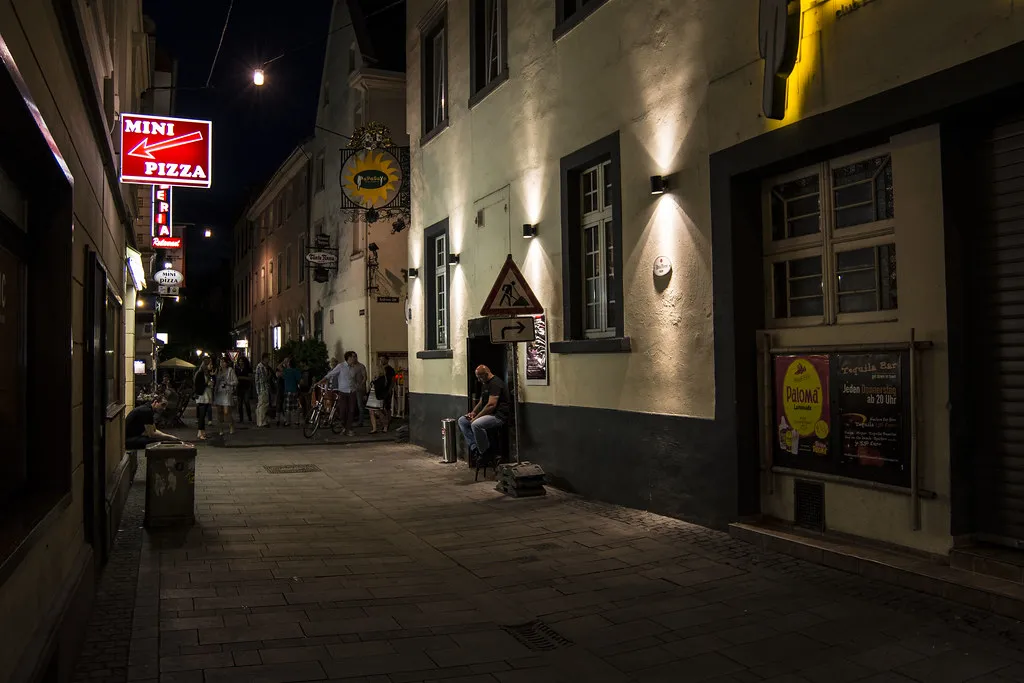
Hans-Albers-Platz, one block south, is where most locals actually hang out. The square is ringed with small pubs, a few live music bars, and Hamburger Berg — a narrow, 150-metre side street where the crowd skews younger and the beer prices drop to around 3.50 Euros. On warm summer nights the square becomes an outdoor living room and people drink on the kerbs until sunrise.
Große Freiheit runs parallel to the Reeperbahn and holds most of the proper clubs — Große Freiheit 36, Docks, Halo, Baalsaal — plus the Indra Club where the Beatles played their first Hamburg residency in 1960. This is the street to aim for if you want to actually dance rather than stand in a beer garden.
Pickpockets work the densest sections between Davidwache and Grosse Freiheit after 02:00, especially near the subway entrance. Keep your phone in a front pocket, keep the wallet on a chain or in an inside jacket pocket, and avoid the men who approach you offering "cheap tickets" or a "special club."
Neighborhoods Beyond the Reeperbahn
Sternschanze (locally just "Schanze") is a 12-minute walk north of the Reeperbahn and is where most under-30 Hamburgers actually drink. The vibe is leftist, slightly grungy, and spills onto the Schulterblatt pavement in summer. Rote Flora, a former theatre squatted since 1989, still anchors the political energy, and the surrounding blocks pack craft-beer bars, Vietnamese kitchens, and underground clubs like Waagenbau and Astra Stube under the railway bridge.
St. Georg, across the Alster from the Hauptbahnhof, is Hamburg's gay district and by far the most relaxed for LGBTQ+ visitors. Lange Reihe is the main artery — cocktail bars, Turkish restaurants, late-night cafés. It is safer than the Reeperbahn after midnight and noticeably less male-heavy in crowd composition.
Ottensen and Eimsbüttel are residential districts that switch on quietly after 21:00. This is where Hamburg locals in their 30s drink wine on a terrace, hear live jazz at smaller venues, and skip the Kiez altogether. If you have already seen the Reeperbahn on a previous trip, these are the neighbourhoods worth a second night.
The Karolinenviertel, sandwiched between St. Pauli and Sternschanze, bridges the two — small bars, political graffiti, the Karoviertel flea market on Saturday mornings. It is a useful buffer if the Reeperbahn feels overwhelming but Schanze seems too far.
Top Clubs in Hamburg
Hamburg's club scene leans techno, house, and indie-rock, with a smaller but respected jazz-and-soul corner. Door prices in 2026 sit between 8 and 25 Euros depending on the lineup; weekday bookers occasionally waive cover before midnight. Cloakrooms cost 2 Euros and are nearly mandatory in winter.
- Uebel & Gefährlich — Feldstraße WWII bunker, fourth floor, the city's most serious techno venue with a door policy to match. Cover 12-20 Euros, Fridays and Saturdays only.
- Mojo Club — Reeperbahn 1, underground jazz-funk-soul venue with an iconic retractable glass roof. Cover 10-18 Euros, strong Sunday programme.
- PAL — Near Messehallen, raw industrial techno with a tight door. Sets run 6-8 hours. Cover 15-20 Euros.
- Golden Pudel Club — Fischmarkt harbourside, cramped, experimental, beloved. Cover 8-12 Euros, often free before 01:00.
- Molotow — Nobistor, the city's indie-rock institution, live bands and late DJ sets. Cover 10-15 Euros.
- Große Freiheit 36 — 1,500-capacity live venue that flips to a pop-chart club after concerts end.
- Docks — Spielbudenplatz, large concert hall with late club nights. Cover 15-25 Euros.
- Baalsaal — Reeperbahn 25, small dark-room house and techno. Cover 10-15 Euros.
- Moondoo — Reeperbahn 136, soul and funk in a stylish mid-size room. Cover 12-18 Euros.
- Halo Club — Große Freiheit, R&B and house, younger crowd. Cover 10-15 Euros.
Door staff at Uebel & Gefährlich and PAL turn away large groups, obvious bachelor parties, and anyone visibly intoxicated. Arriving in pairs, dressing dark, and speaking minimally in the queue raises your odds. If refused, do not argue — move on to Molotow or Moondoo instead.
Drinks and a Good Time in Bars and Pubs
Hamburg's bar scene ranges from Germany's best cocktail lab to sticky-floor Kiez dives where Astra beer is 3 Euros. Le Lion on Rathausstraße is the benchmark — a speakeasy that reinvented the Gin Basil Smash in 2008 and still appears on most "world's 50 best bars" lists. Expect 13-16 Euros per cocktail and a low-lit room dressed like a 1920s hotel lobby.
Zum Silbersack on Silbersackstraße is the opposite end of the spectrum — a rowdy student haunt pouring 3.50-Euro beers since 1949, with sticky floors, air-guitar choruses, and no pretense. Hamburger Berg 2 nearby has a similar no-frills vibe with better music.
Sternschanze is the craft-beer corridor. Buddel-Bini and Ratsherrn Tap Room pour Hamburg-brewed pilsners and IPAs at 4.50-6.50 Euros. Le Fonque runs a strict vinyl-only policy — funk, soul, boogie, disco — and the room stays packed with a local crowd until 04:00.
For a relaxed evening, the Sofabars (Zoë II and Zoë III on Mittelweg) swap chairs for vintage couches and lean into low-key cocktails. Many visitors also cross-check the best bars in hamburg list before plotting a bar crawl, since openings shift seasonally. Most bars open at 18:00 or 19:00 and run until 04:00 or later on weekends.
Live Music & Concert Dates
Hamburg is Germany's music city. The Beatles spent 281 nights performing here between 1960 and 1962 at the Indra, Kaiserkeller, Top Ten, and Star-Club, and the "Beatles-Platz" roundabout at the corner of Reeperbahn and Große Freiheit marks the epicentre. Self-guided Beatles walks leave from Beatles-Platz every day; the Indra Club still operates as a live venue.
Große Freiheit 36 hosts mid-size international acts — 1,500 capacity, strong rock and indie bookings. Smaller venues like Molotow, Knust in Karoviertel, and Uebel & Gefährlich's main hall cover emerging bands and post-punk. Mojo Club runs jazz and soul residencies on Sundays and Mondays when most of the city is quiet.
The Elbphilharmonie on the harbour sells standing tickets from 12 Euros for contemporary classical shows — a serious budget hack for visitors who want the building but not the 100-Euro subscription seats. The Plaza observation deck is free but needs a timed ticket booked a day ahead.
Every September the Reeperbahn Festival takes over 90 venues across St. Pauli — 600 shows in four days, one wristband covers all of them. If your trip overlaps, it is the single best night-out concentration in Europe. Check the official Hamburg.com concert calendar for other dates.
Local Rules Most Tourists Miss
Hamburg has three specific nightlife rules you will not find in other German cities, and none of them are mentioned in the major tourist guides. Breaking them will get you fined, turned around, or embarrassed — so worth skimming before the first night out.
Herbertstraße is men-only and women-forbidden. This 60-metre alley between Davidstraße and Gerhardstraße is one of only two legally women-excluded streets in Germany and is fenced off with tall metal screens so nobody can see in. It is an active prostitution zone, not a tourist curiosity, and any woman or minor who enters will be verbally and sometimes physically confronted. Take the photo from outside the screens if you need it and move on.
The glass-bottle ban on the Kiez runs Friday and Saturday from 22:00 to 06:00. Introduced in 2009 after a series of bottle-attack injuries and still enforced in 2026, it covers the Reeperbahn, Große Freiheit, Hans-Albers-Platz, Spielbudenplatz, and the surrounding side streets. Kiosks switch to aluminium cans during those hours. Carrying a glass bottle gets you a 25-Euro on-the-spot fine and a bottle confiscation from the patrolling "Kiez-Streife" officers.
The Friday-night Partymeile gets a one-way pedestrian flow after 23:00. Between April and October, Davidstraße and the Reeperbahn crossing are physically barriered and pedestrians are pushed eastbound only. If you miss the sign and try to cut back through the crowd, the Davidwache officers will route you around, which can add 10 minutes in peak season. Just follow the flow.
Doing Something Spontaneously Tonight
Showing up in Hamburg without a plan is genuinely fine — the density of the Reeperbahn and Schanze means you can walk into any bar and find something within 60 seconds. For structured last-minute options, check Eventbrite.com for DJ sets, Mojo Club's weekly schedule, or the Reeperbahn Festival's pop-up shows in September.
Most clubs sell door tickets cash-only between 10 and 25 Euros. Weekday lineups (Thursday, Sunday) are cheaper, less crowded, and often higher quality than the tourist-packed Saturday nights. Arriving before midnight at Uebel & Gefährlich or Mojo Club usually means a waived cover and a free cloakroom slot.
If the Reeperbahn feels too chaotic, walk 10 minutes north to Sternschanze's Schulterblatt — within three blocks you will find craft-beer bars, live jazz, Vietnamese food, and a late-opening wine bar. The area is a natural pressure-valve from the Kiez and consistently ranks as the locals' first choice.
For a softer evening, the HafenCity harbour promenade and Speicherstadt canals light up dramatically after dark. Evening canal barge tours run until 23:00 in summer at 22-28 Euros per head and are a quiet counterweight to a heavy Kiez night.
Safety and Security on the Kiez
The Reeperbahn is heavily policed — the Davidwache station sits directly on Spielbudenplatz and is one of the most incident-dense police stations in Germany. Uniformed officers and the plain-clothes Kiez-Streife patrol the strip continuously on Friday and Saturday nights, so help is always within 90 seconds.
Most major venues station professional security at the door and enforce camera stickers on smartphones inside exclusive clubs. Uebel & Gefährlich, PAL, and Baalsaal will tape your phone camera on entry; taking photos inside will get you ejected without a refund. This is standard German club culture and nothing to argue with.
Keep ID on you — Germany requires a photo ID by law, a passport or EU ID card works, a driver's licence does not. Door security can and will ID anyone who looks under 25. The legal drinking age is 16 for beer and wine, 18 for spirits, so any spirit-heavy cocktail bar will card more strictly.
The standard warnings apply: do not accept drinks from strangers, avoid the unlabelled "tourist menus" displayed outside some strip clubs (typical overcharging scam), and plan your route home before the first drink. U3 and S-Bahn run all night on Fridays and Saturdays, and Davidwache will call a licensed taxi for anyone who asks.
Payment Methods and Cash Strategy
Germany is still a cash-first country and Hamburg's Kiez is the cash-heaviest corner of it. Plan for 40-60 Euros in cash per person per night even if you intend to pay by card. Many bars set a 20-Euro card minimum and some smaller Kiez pubs are cash-only with no card terminal at all.
Larger clubs — Uebel & Gefährlich, Mojo Club, Docks, Große Freiheit 36 — accept Visa, Mastercard, and increasingly Apple Pay and Google Pay at the bar. Cover charges at the door are almost always cash-only regardless of venue size. Always bring enough cash to cover the door itself.
ATMs cluster densely on the Reeperbahn and around U-Bahn St. Pauli, but the standalone "Euronet" machines charge 3.50-5.50 Euros per international withdrawal. Use Deutsche Bank, Commerzbank, or Sparkasse ATMs instead — they charge international cards a more reasonable 1.50-3.50 Euros and are dotted along Große Bergstraße and Reeperbahn itself.
Tipping is standard: round up to the next Euro on a beer, add 10% on a cocktail, and tell the bartender the full amount (e.g. say "zehn" for a 9-Euro drink) rather than waiting for change. Coatroom staff expect 1-2 Euros extra at the end of the night, on top of the 2-Euro hanging fee.
Before You Go — Plan Your Night
Dress codes are softer in Hamburg than in Berlin but stricter than Munich. The Kiez dive bars and Schanze clubs accept anything; cocktail bars like Le Lion and upscale lounges lean smart-casual but never require a suit. Major techno clubs (Uebel & Gefährlich, PAL) reward dark, simple, non-flashy clothing — no logos, no large groups, no bachelor-party uniforms.
Eat before you drink. German pubs serve food but most Kiez bars stop kitchen service around 22:00. Sternschanze is the best pre-drinking neighbourhood for a proper meal — Schulterblatt has 20+ restaurants serving until midnight and Bullerei (Tim Mälzer's bistro) is worth the booking a week ahead.
Book accommodation outside St. Pauli if you want to sleep. Hotels directly on the Reeperbahn get noise complaints every weekend; Sternschanze, St. Georg, or Neustadt are all one U-Bahn stop away and noticeably quieter. A Friday-night St. Pauli hotel room at 120 Euros often sits next door to a 180-Euro Sternschanze room where you can actually sleep until 10:00.
Weekends book out fast from April to October and during the Reeperbahn Festival (mid-September), Hafengeburtstag (May), and the Dom funfair (three times a year). Midweek stays are 30-50% cheaper and the clubs are less touristy.
See Hamburg's Hidden Side on a Local Tour
Guided Kiez tours are heavily oversupplied around the Reeperbahn — avoid the "free" tip-based walks which are usually low-quality and push you into overpriced bars. The better bookings are through local licensed guides, St. Pauli Tourist Office on Davidstraße 17, or City Unscripted's private tour network.
A typical 2-hour tour costs 25-45 Euros per person and covers the Reeperbahn history (from 1618 rope-makers' lane to 1960s Beatles years to 2026 gentrification pressure), the Herbertstraße rule, and off-Kiez hidden courtyards like the Zirkusweg community garden. The best guides are former St. Pauli residents who know which bars still welcome locals and which have tipped fully into tourist traps.
Beatles-focused tours leave from Beatles-Platz daily at 18:00 (April-October) and last around 2.5 hours. For 22 Euros you get the five venue sites, archival photos on a tablet, and the backstory on why the band's Hamburg years mattered more than Liverpool ones. Tripadvisor (Tripadvisor.com) filters Kiez tours by language — Spanish, Italian, and French guides are available with 48 hours' notice.
Business, Media, and the Kiez Economy
The Reeperbahn district employs roughly 5,000 people in hospitality and entertainment and generates over 150 million Euros a year in licensed turnover. The city of Hamburg actively protects St. Pauli's mixed-use character through the 2009 "Soziale Erhaltungsverordnung" which limits rent increases and change-of-use permits — the reason the strip still hosts dive bars next to condos rather than a clean Times-Square redevelopment.
Professional networking in Hamburg rarely happens in Kiez clubs. It happens in the trendy Schanze bars, HafenCity rooftops, and Hotel Atlantic's lobby bar on the Alster. Media and publishing professionals — Der Spiegel, Gruner + Jahr, Die Zeit all have their headquarters here — tend to meet at Watt in Schanze or at the Fischereihafen restaurant in Altona.
The Reeperbahn also hosts the annual Reeperbahn Festival Conference (September), Europe's largest music industry meeting after Eurosonic — 5,000 delegates, label scouts, and artists across 90 venues. If your Hamburg visit has any professional component in music, media, or live events, September is the logical window.
Explore More Hamburg Guides
Keep planning your Hamburg trip with these guides.
Explore nightlife in other cities
Frequently Asked Questions
Which hamburg nightlife options fit first-time visitors?
First-time visitors should start on the Reeperbahn to see the iconic neon lights and famous venues. This area provides a high-energy introduction to the city's unique culture and history. You can find more specific recommendations for your first night out at Hamburg.com.
How much time should you plan for hamburg nightlife?
You should plan at least one full evening to explore the main districts, but two nights allow for a deeper experience. Most clubs do not get busy until after midnight, so prepare for a very late night. Many travelers stay out until the early morning hours to visit the famous Fish Market.
What should travelers avoid when planning hamburg nightlife?
Avoid carrying too much cash or wearing very expensive jewelry in the most crowded tourist areas of St. Pauli. Do not engage with aggressive street promoters who try to lure you into unknown adult venues. Staying with your group and using official transport will help you avoid the most common travel mistakes.
Is hamburg nightlife worth including on a short itinerary?
Yes, the nightlife is a central part of the city's identity and should not be missed even on a short trip. Even a few hours spent in a traditional pub or a historic music venue will provide lasting memories. It offers a unique cultural perspective that you cannot find during the daylight hours.
Hamburg offers a legendary nightlife experience that is both diverse and deeply rooted in musical history.
From the wild energy of the Reeperbahn to the cozy bars of Sternschanze, there is something for everyone to enjoy.
By planning ahead and staying safe, you can fully immerse yourself in the vibrant spirit of this historic German port city.
Prepare for an unforgettable night of music, dancing, and local culture in one of Europe's most exciting destinations.


