
7 Best Neighborhoods and Tips for Valencia Nightlife
Valencia runs on a later clock than almost any other European city. Dinner starts at 22:00, bars fill after midnight, and the main clubs do not peak until 03:00. By the official schedule, pubs close at 03:30 and clubs stay open until 07:30, giving you one of the longest party windows on the continent.
The scene is split across five very different districts. El Carmen is the bohemian old town, Ruzafa is the hipster heart, the Marina and Malvarrosa beach take over in summer, the City of Arts and Sciences hosts the most polished clubs, and the university belt around Blasco Ibáñez is where students drink cheaply all week. Each area has its own dress code, music style, and peak hour.
This guide breaks down where to go by neighborhood, what to drink, how to survive the late Spanish schedule, and the practical things competitors skip — the Fallas-week disruption in March, the specific N-bus routes home, and the difference between an authentic Agua de Valencia and a tourist pour. For broader context on nightlife experiences in Spain, Valencia sits between Madrid's formality and Barcelona's beach-club scale, with friendlier prices than either.
Key Takeaways
- Bars fill at 23:30, clubs peak after 03:00, and licensed venues stay open until 07:30 on weekends.
- El Carmen delivers the historic bar crawl; Ruzafa has the smartest cocktail scene; Marina clubs only matter June through September.
- Agua de Valencia is the city's signature cocktail — order it by the pitcher at Café de las Horas, not from a pre-bottled jug.
- Avoid planning a big night out during Fallas (March 15–19): streets are jammed with fireworks and most clubs shift to daytime verbenas.
- Use EMT N1–N10 night buses (1.50€) or the Friday/Saturday 24-hour metro on lines 3, 5, and 9 to get home for under 2€.
- Botellón (drinking on the street) is fined 300–600€ under Valencia's municipal ordinance — stick to licensed terraces.
The Spanish Schedule: When to Start Your Night in Valencia
Timing is the single most common mistake first-time visitors make. Valencians eat dinner between 21:30 and 23:00, so arriving at a bar at 21:00 will feel like walking into an empty room. The pre-dinner move is a caña (small beer) or vermouth on a terrace, often between 20:00 and 21:30. Sit down for food after that.

Bars properly fill between 23:30 and 01:00. This is the window for Agua de Valencia pitchers in El Carmen, gin and tonics in Ruzafa, or a rooftop drink on Calle Colón. Clubs do not get busy until 02:30 or 03:00, and the peak hour is closer to 04:00. If you arrive at Mya or Akuarela before 01:30, you will likely be the only one on the floor.
Legally, pubs close at 03:30 and discotecas at 07:30, though most clubs wind down between 06:00 and 06:30. The cultural commitment is to last until sunrise — ending with churros con chocolate at Horchatería Santa Catalina or a 24-hour bakery is the local ritual. Plan a nap before you go out and do not try to keep up with a 20:00 bar crawl schedule; the rhythm here simply does not work that way.
Weeknights are quieter but not dead. Thursdays are the student big night around Benimaclet and Plaza Xúquer. Sundays are for tardeos — late-afternoon drinking sessions that start at 17:00 and end by midnight, which is the one night a European schedule actually applies.
El Carmen: Historic Streets and Bohemian Vibes
El Carmen is the medieval old town and the default starting point for any first-time night out. The streets are narrow, the architecture is 15th-century, and the bar density around Plaza del Tossal, Plaza Negrita, and Plaza del Doctor Collado is unmatched in the city. You can reasonably do a bar crawl on foot without crossing more than three blocks.
The anchor venue is Café de las Horas on Calle del Conde de Almodóvar. It opens at 16:00, serves Agua de Valencia by the pitcher (around 22–28€ for a jug that serves four), and has a neo-baroque interior packed with candles and velvet. The competition down the street — Radio City on Calle Santa Teresa — pivots from bar to live venue around 23:30, with flamenco on Tuesdays, DJs Wednesday through Sunday, and entry around 6–10€ after midnight.
Café Negrito on Plaza del Negrito is the terrace everyone meets at for the first drink; expect to pay 4€ for a vermouth and 3€ for a caña. Jimmy Glass on Calle Baja is the jazz cellar — cover is 10–15€ depending on the act, sets start at 21:30, and you will want to book a seat for weekend nights. For flamenco with dinner, Café del Duende on Calle Túria runs Thursday, Friday, and Saturday shows around 22:30.
You can find many top-rated bars in Valencia concentrated in this neighborhood, and the area is walkable from any hotel inside the old town ring. Dress is casual: jeans and a shirt are fine everywhere, and sneakers are accepted even at the more design-forward spots.
Ruzafa: The Trendy Heart of Valencia's Nightlife
Ruzafa sits south of the train station and functions as Valencia's Kreuzberg or Shoreditch equivalent. Ten years ago this was a working-class neighborhood; now it has the city's densest cluster of craft cocktail bars, natural wine shops, and small venues playing indie and house. Dinner prices run 20–35€ per person at spots like Canalla Bistró or Dos Estaciones, which is where most nights here begin.
Café Berlin on Calle Pinzón is the warm-up: low red lighting, a serious cocktail list starting at 9€, funk and soul on the stereo. Café Tocado nearby has the Moulin Rouge interior and a gentler volume — good for conversation before things escalate. The dance floors are Oven Club on Gran Vía Germanías for techno (cover 12–15€, peak around 03:00) and Play Club on Calle Reina Doña María for indie and pop-rock with two smaller rooms (cover 10€ including a drink).
The crowd skews older than El Carmen — late 20s to late 30s — and the dress code shifts to smart-casual. No athletic shorts, but nice sneakers and a button-down are standard. Terrace weather stretches from April to late October thanks to the Mediterranean microclimate, and most bars have outdoor seating on Calle Cuba and Calle Sueca.
Finding excellent clubs in Valencia is straightforward once you orient around these two Ruzafa blocks. Arrive by 00:30 on a Saturday if you want a terrace table; after 01:30 you will be standing.
Neighborhood Comparison: Where to Go Tonight
Every Valencia guide lists the same five districts, but none of them puts the trade-offs side by side. Use this as a quick decision matrix: pick the vibe you want, match the budget, and cross-reference the peak hour so you do not arrive three hours early.
| Neighborhood | Vibe | Average Drink Price | Peak Hour | Dress Code | Best Season |
|---|---|---|---|---|---|
| El Carmen | Bohemian, historic | 4–8€ | 23:30–02:30 | Casual | Year-round |
| Ruzafa | Hipster, design-led | 7–12€ | 00:30–04:00 | Smart-casual | Year-round (terraces Apr–Oct) |
| Marina / Malvarrosa | Beach club, glamorous | 10–16€ | 02:00–06:00 | Summer chic | June–September |
| City of Arts & Sciences | Polished, architectural | 10–14€ | 02:30–05:00 | Smart / shirt required | Year-round (L'Umbracle Jun–Oct) |
| Blasco Ibáñez / University | Student, high-energy | 2–5€ | 00:00–03:00 | Very casual | Term time (Sep–June) |
If you only have one night, El Carmen wins for breadth. If you have two nights and want contrast, do El Carmen on day one and Ruzafa on day two. In summer, swap one of those for the Marina. Avoid stacking too many neighborhoods in one night — the Marina is a 20-minute taxi from the old town and the last metro home does not cover it.
The Marina and Beach: Summer Parties by the Sea
From June through September the center of gravity shifts east. The Marina Real Juan Carlos I — the former America's Cup harbor — and the Malvarrosa beach promenade take over as the default Friday and Saturday destination. This is the only time of year when the inland neighborhoods quiet down, because every student and every expat heads for the water.
Marina Beach Club is the flagship: a day-to-night complex with an infinity pool, beachfront restaurant, and a club that runs until 06:00. Table bookings for weekends in July and August need to go in two to three weeks ahead, and expect minimums of 200–400€ per table. General entry is 20–25€ including one drink. Akuarela Playa on Calle de Eugenia Viñes is the bigger, more commercial option — two floors, a garden, Latin and commercial hits, and a younger crowd (18–24). Tickets run 12–18€ and you can book through Akuarela Playa tickets to skip the queue.
For a more relaxed evening, La Fábrica de Hielo on the Malvarrosa seafront is a converted ice factory with live music, a beach terrace, and no cover. It is the after-dinner alternative before hitting a club. La 3 on Avenida Blasco Ibáñez (not directly on the beach but close enough) runs commercial and reggaeton, with the biggest student nights on Thursdays and Fridays.
Pair your night with a day on Valencia's beaches if the weather cooperates — most Marina venues open their loungers from 12:00 and flip to club mode around 20:00. The dress code here is summer chic: linen shirt or sundress, nice sandals, no flip-flops inside the velvet rope.
City of Arts and Sciences: Sophisticated Clubbing at Mya
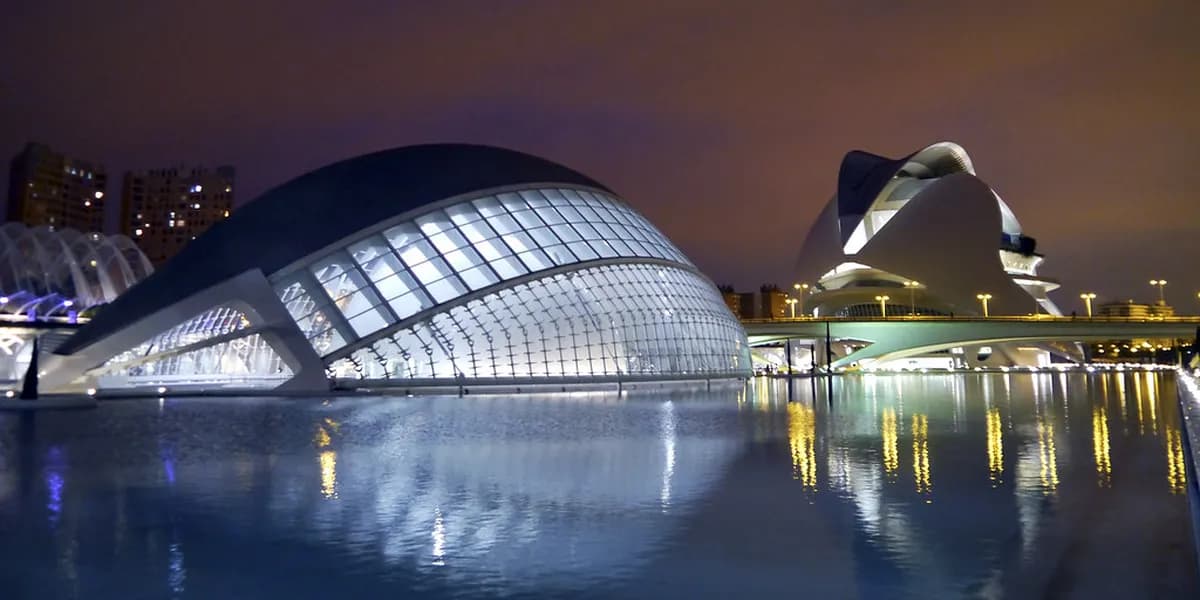
The Calatrava complex south of the old town hosts the two most polished venues in the city. L'Umbracle — the glass-roofed tropical walkway — converts into an open-air club from June through September. Entry is around 15–20€ with one drink, doors open at 00:00, and the first hour is quiet before the crowd shifts over from dinner in the old town.
Directly below, Mya runs year-round on Thursday, Friday, and Saturday plus special event nights. Two main rooms split commercial house and more club-oriented electronic music; a single ticket in summer covers both Mya and L'Umbracle upstairs. Cover is 15–25€ depending on the DJ and day. Peak time is 03:00–05:00 on Saturdays.
The dress code here is the strictest in the city. Men need long trousers and closed-toe shoes — leather sneakers pass but running shoes and athletic gear are turned away at the door. A collared shirt is safer than a t-shirt. Women have more flexibility but most guests lean toward heels and a dress. The door staff is genuinely selective between 02:00 and 03:30 when the queue is longest.
Around the corner, 48 Music Bar and On The Rocks on Avenida de Francia are the warm-up spots — both take a slightly less formal crowd and run later into the morning if Mya closes before you are ready to leave.
University District: High-Energy Student Bars and Clubs
The belt along Avenida Blasco Ibáñez, Plaza Xúquer, and Plaza del Cedro caters to Valencia's 60,000+ university students and the large Erasmus population. This is the cheapest nightlife in the city: a caña runs 1.50–2€, a mixed drink is 4–6€, and many clubs offer free entry for Erasmus card holders on Thursdays.
Plaza Xúquer is the meeting point for a chupito crawl — a succession of 1€ shot bars that build up to the club phase. La3 on Blasco Ibáñez is the main dance floor, with commercial hits, reggaeton, and Latin nights; entry is 8–12€ and the Thursday session is more packed than many Saturdays. Agenda Club near the Polytechnic campus runs indie and alternative. Committee Club (now rebranded Mayimbe) near Joaquín Sorolla station plays chart hits and frequently drops cover for student groups.
Benimaclet, one metro stop further north, is the quieter bohemian alternative — fewer clubs, more live-music bars and cooperatives. Tyris on Tap and La Senda have craft beer, acoustic sets, and a neighborhood feel. This is where students go when they want to hear themselves think.
If you are staying in the center and want to visit the university district, budget for a taxi home — the last metro toward Blasco Ibáñez leaves Xàtiva station around 23:00 on weekdays, though the weekend 24-hour lines cover the route. Cabify and FreeNow fares from the old town run 8–12€.
Agua de Valencia: The Drink to Order and Where to Find the Real Thing
Agua de Valencia is the city's signature cocktail and the one drink every visitor is told to try. It was invented in 1959 at Cervecería Madrid by bartender Constante Gil, allegedly after a group of Basque tourists ordered "agua de Valencia" as a joke and got served a new creation instead of tap water. The classic recipe is fresh-squeezed Valencia orange juice, cava, gin, vodka, and sugar — served cold in a pitcher (jarra) to share among four.
The authenticity test is simple. Watch the bartender squeeze the oranges. Real Agua de Valencia is made to order; the tourist version comes out of a pre-mixed bottle behind the bar and tastes flat and overly sweet. A genuine jarra runs 20–28€ at a respected spot and 10–15€ at a tourist-grade bar where you are effectively drinking orange soda with cheap cava.
The reference venue is Café de las Horas in El Carmen — it has been serving the cocktail since the 1980s, and the bar staff squeeze the juice behind the counter. Other solid options: Sant Jaume on Calle Caballeros (smaller, more local, 22€ jug), the original Cervecería Madrid nearby for the historical value, and La Catedral del Vino for a wine-bar spin on the recipe. Avoid any place on Plaza de la Reina or the first block of Calle de la Paz that advertises "Agua de Valencia" on a chalkboard with a picture — those are the highest-markup tourist pours in the city.
Drink it slowly. The cava masks the alcohol and a four-person jarra typically contains the equivalent of eight standard drinks. Pair it with a plate of patatas bravas and do not plan to drive or make important decisions afterward.
Fallas and Other Seasonal Disruptions to Know About
Valencia's biggest festival — Las Fallas, officially March 15–19 — is also the single most disruptive event for the normal nightlife schedule, and no competitor guide explains this clearly. During Fallas week, streets in the old town are closed for the 300+ wooden monuments, fireworks (mascletàs) rattle the city at 14:00 daily, and entire neighborhoods become walking-only. Most El Carmen bars stay open but switch to daytime verbenas — outdoor street parties with brass bands and beer tents — rather than the usual club-oriented late-night schedule.
If you want the Fallas experience itself, come for it. If you want a standard Valencia night out — Mya, Marina Beach Club, Ruzafa cocktail bars — avoid the week of March 13–20. Hotel prices triple, taxi availability collapses after 22:00, and many of the polished clubs run reduced programs or close entirely. The weekend immediately after Fallas (March 21–22 in 2026) is the reverse: the city empties out as locals recover, and you will find unusually quiet clubs.
Other dates to plan around: the San Juan bonfires on June 23 pack Malvarrosa beach until dawn — not a standard club night, but an open-air festival you should join if the timing works. August sees many El Carmen bars close for two weeks when owners take summer holidays; the Marina picks up the slack. December 24 and December 31 both run special galas with advance tickets required at Mya, Marina Beach Club, and L'Umbracle — expect 40–80€ covers and strict dress codes.
Outside these windows the schedule is reliable: Thursday through Saturday are the big nights year-round, with Sunday tardeos adding a fourth option in spring and autumn.
Practical Tips: Transport, Dress Codes, and Safety
Getting home is the practical problem every first-timer underestimates. Metrovalencia's weekday service stops around 23:30, but on Friday and Saturday nights lines 3, 5, and 9 run a 24-hour service connecting Xàtiva station with Marina/Neptú and the airport. A single fare is 1.50€; a 10-trip Bonometro is 8€. Check the Metrovalencia app the night of — schedules do shift during Fallas and major holidays.
The EMT night bus network runs the N1–N10 lines from Plaza del Ayuntamiento and covers every major neighborhood including Malvarrosa (N9), Benimaclet (N3), the City of Arts (N8), and the university district (N1). Buses leave every 45–60 minutes between midnight and 06:00, the fare is 1.50€ on board or 1€ with a SUMA card, and the EMT app shows live departures. Taxis are plentiful at the standard ranks (Plaza de la Reina, Xàtiva station, Malvarrosa boardwalk); a fare from Marina to the old town runs 12–16€. Cabify and FreeNow work everywhere in the city.
Botellón — drinking alcohol in the street — is illegal under Valencia's municipal ordinance, with fines of 300–600€ if you are caught with an open container in a public plaza, park, or beach after 22:00. Enforcement is selective but real, especially around Plaza de la Virgen and Malvarrosa in summer. Stick to licensed terraces: any chair that belongs to a bar is fair game; any stoop or beach towel is not.
Valencia is one of Spain's safest cities for nightlife, with very low violent-crime rates. Standard precautions apply: keep your phone in a front pocket in crowded El Carmen alleys, watch your bag on Marina beach terraces where bag-snatching is the main risk, and do not leave drinks unattended at large Marina clubs. Emergency number is 112 and the Policía Local night patrol is visible in the old town until 04:00.
Explore More Valencia Guides
Keep planning your Valencia trip with these guides.
Explore nightlife in other cities
Frequently Asked Questions
Where should I go for a night out in Valencia?
The best place depends on your personal style and the season. El Carmen is ideal for a bohemian and historic vibe with many small bars. Ruzafa offers a trendy, hipster atmosphere, while the Marina is the top choice for summer beach parties. Each district provides a unique way to experience the local scene.
What time do clubs open in Valencia?
Most clubs in Valencia officially open around midnight, but they remain empty for several hours. The real action usually begins between 2:00 AM and 3:00 AM. If you want to see the venues at their peak, plan to arrive late and stay until sunrise. Many spots do not close until 6:00 AM or 7:00 AM.
What is Agua de Valencia and where should I try it?
Agua de Valencia is a famous local cocktail made with cava, fresh orange juice, vodka, and gin. It was created in 1959 at Cervecería Madrid. For the most authentic and atmospheric experience, visit Café de las Horas in El Carmen. It is a delicious but powerful drink that is perfect for sharing with friends.
Is there a dress code for Valencia clubs?
Dress codes vary significantly across the different neighborhoods of the city. El Carmen and the University District are very casual, where jeans and t-shirts are common. However, upscale venues like Mya or Marina Beach Club require smarter attire. Men should generally wear long pants and closed-toe shoes to these higher-end locations.
How do I get home after a night out in Valencia?
You can use the 'N' night buses which run from Plaza del Ayuntamiento to most neighborhoods. On weekends, the Metrovalencia often provides late-night or 24-hour service on specific lines. Taxis are also plentiful and can be hailed on the street or booked via apps like FreeNow or Cabify. Check out the best clubs in Valencia to plan your transport route.
Valencia rewards visitors who learn its clock and its districts. Start late, choose your neighborhood by the vibe you want, and budget for the right dress code once you cross into Marina or City of Arts territory. A pitcher of Agua de Valencia at Café de las Horas, a set at Radio City, a beach-club sunrise at Akuarela, and a Sunday tardeo in Ruzafa are the four archetypal Valencia nights — mix and match based on how many evenings you have.
Avoid the first two weeks of March if you want a standard nightlife trip, book Marina tables a fortnight ahead in summer, and keep 3€ in coins for the N-bus home. The city is safe, affordable by western European standards, and — thanks to the late-night licensing — has one of the longest party windows on the continent.
Bookmark this guide for the specifics: neighborhood peak hours, cover prices, authentic versus tourist-grade bars, and the transport routes that get you back to your hotel without a 30€ cab fare. Every other detail will fall into place once you are on Calle Caballeros with a drink in hand.


