
11 Best Pubs and Nightlife Areas in Madrid
Madrid has more bars per capita than any other European capital, and the gap between the best and the worst is wider than most visitors expect. The Spanish capital runs on a communal drinking rhythm that starts with vermouth around 13:00 and does not peak until well past midnight. Whether you want a sherry poured from a wooden cask or a neon-lit cocktail on a short list of the world's fifty best, the variety here rewards a little local knowledge.
This 2026 guide focuses on eleven pubs and nightlife areas that hold up to scrutiny from both residents and first-time visitors, with current opening hours and euro price ranges verified in February. Several of these bars predate the Spanish Civil War and still enforce their original house rules, while others represent Madrid's modern mixology boom documented by The World's 50 Best Bars.
The goal is to help you avoid the overpriced terraces near Plaza Mayor and find the sherry cellars, vermouth taverns, and cocktail dens that locals actually drink at. Expect to rotate between two or three neighborhoods in a single night, and expect the real energy to arrive after 23:00.
El Anciano Rey de los Vinos
Facing the Almudena Cathedral and the Royal Palace in the Austrias district, El Anciano Rey de los Vinos opened in 1909 and still serves vermouth drawn straight from the cask. The red facade is a holdover from a time when most Madrileños could not read, signalling that wine was sold inside. The house torrijas, bread soaked in sweet wine and fried, are worth the short queue in spring.
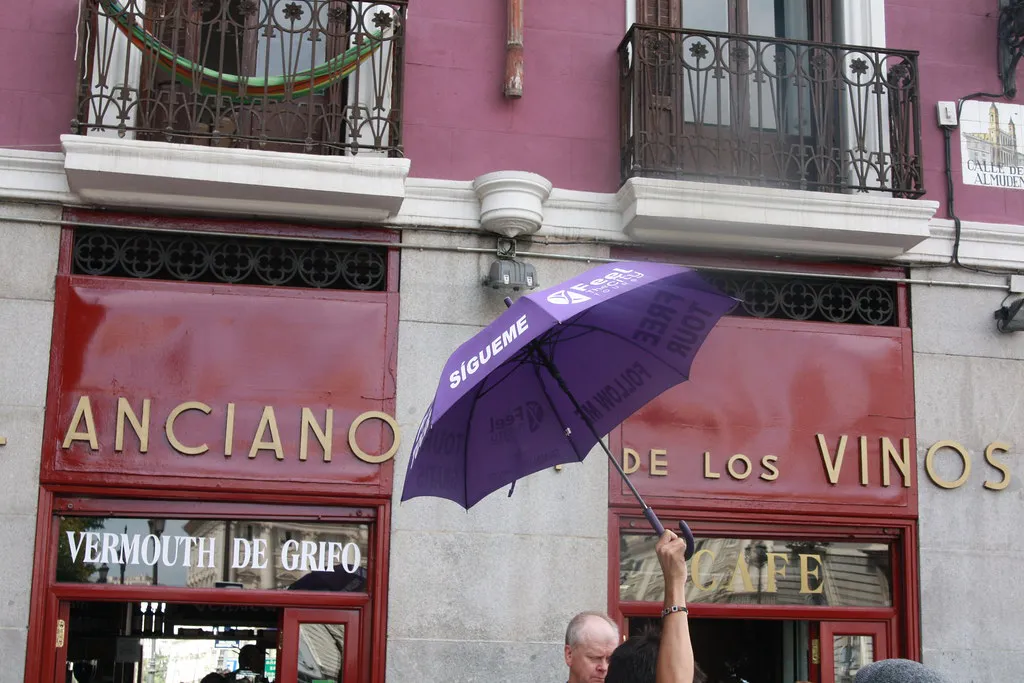
- Best for history and daytime vermouth de grifo before a walk to the palace.
- Drinks and small plates run 4 to 15 euros; torrijas are 3 to 5 euros.
- Open 10:00 to 00:00 daily; outdoor tables fill fastest between 13:00 and 15:00.
- Order the Cazuela del Anciano or Callos a la Madrileña if you want a full lunch.
Casa Labra
A block from Puerta del Sol, Casa Labra has operated since 1860 and is the exact room where the Spanish Socialist Party was founded on 2 May 1879. The plaque on the outside wall commemorates that meeting. Today the bar is famous for two things: croquetas de bacalao and soldaditos de Pavía, both eaten standing at the tile-covered counter.
- Best for bacalao tapas and a taste of working-class Madrid history.
- Beer, wine, and tapas run 2 to 12 euros; there is no table service charge at the bar.
- Open 11:00 to 15:30 and 18:00 to 23:00 daily; expect a shoulder-to-shoulder crowd at 14:00.
- Order at the door, collect at the bar, and tip only your small change.
La Venencia
La Venencia on Calle Echegaray is the strictest bar in central Madrid and also one of its most rewarding. Founded in the 1930s and favoured by Republican soldiers and Hemingway during the Civil War, it serves only sherry, poured from the barrel and priced on the wooden counter in chalk. Two house rules have survived ninety years unchanged: no photographs and no tipping, both enforced politely but without exception.
- Best for fino, manzanilla, and amontillado sherry in a room that has not been redecorated since the 1940s.
- Glasses of sherry run 2.50 to 5 euros; olives, cheese, and mojama are 3 to 7 euros.
- Open 12:30 to 15:30 and 19:30 to 01:30 most days; closed some Sundays.
- Put your phone away before the door, ask the bartender to recommend a fino, and pay your tab at the end.
Salmon Guru
Diego Cabrera's Salmon Guru on Calle Echegaray has sat on The World's 50 Best Bars list for years and is the clearest example of Madrid's modern cocktail credentials. The room is loud, colourful, and full of glassware shaped like skulls, octopuses, and rubber ducks. The drinks are serious, built on multi-step infusions, but the staff will happily adapt a cocktail to your palate on request.
- Best for high-concept cocktails and a reservation-friendly late-night stop.
- Signature cocktails run 14 to 22 euros; a small bar-snack menu runs 6 to 14 euros.
- Open 17:00 to 02:30 Tuesday to Saturday; closed Sunday and Monday.
- Book online forty-eight hours ahead for a Friday or Saturday seat at the bar.
Casa Alberto
Casa Alberto on Calle Huertas opened in 1827 in the building where Miguel de Cervantes once lived and still keeps its original zinc counter. Bullfighters used to drink vermouth here before an afternoon at Las Ventas, and the walls carry enough faded photographs to prove it. The vermouth is house-blended, the albóndigas de rabo de toro are famous, and the service is faster if you stand.
- Best for vermouth on tap paired with heavy Madrid classics like oxtail meatballs.
- Drinks run 3 to 8 euros; tapas and raciones run 5 to 20 euros.
- Open 12:00 to 01:30 Tuesday to Saturday; Sunday 12:00 to 16:00; closed Monday.
- Stand at the bar for a cheaper caña, or reserve a back table for a full sit-down meal.
Museo Chicote
Museo Chicote on Gran Vía is the oldest cocktail bar in Madrid, opened in 1931 by Perico Chicote and decorated in a sinuous Art Deco style that has survived every trend since. Hemingway drank here while covering the Civil War, Ava Gardner and Frank Sinatra drank here during Hollywood's Spanish boom, and the black-and-white photographs on the wall are the best evidence. Classic cocktails are the strength; modern creations are competent but not the reason to come.
- Best for a classic martini or gin tonic in a room full of 20th-century ghosts.
- Cocktails run 12 to 18 euros; there is usually no cover before 23:00.
- Open 19:00 to 03:00 daily; DJs set up after 00:00 Thursday to Saturday.
- Ask for the original house Martini recipe rather than the current cocktail menu.
Areia Colonial Chillout
Areia on Calle Hortaleza offers the exact opposite of a dark historic tavern: low cushions, Moroccan lanterns, and a sand-covered summer floor. It is the easiest bar in central Madrid for a group that cannot agree on music or style, and it works equally well for a quiet lunch or a late DJ set. The cocktail list leans tropical rather than classic, and the bar snacks skew Middle Eastern.
- Best for groups who want lounge seating instead of a standing bar.
- Cocktails run 9 to 14 euros; shared mezze plates run 8 to 18 euros.
- Open 13:00 to 02:30 daily with DJs from 22:00 Thursday to Saturday.
- Arrive before 21:00 on weekends to claim floor cushions in the back rooms.
Casa de la Torrijas
Casa de la Torrijas, officially Antigua Casa de las Torrijas on Calle de la Paz, has served its namesake sweet since 1907 inside a tile-and-mirror interior that was already fashionable in 1907. The torrijas are soaked in sweet wine rather than milk and sold year-round, not only at Easter. Expect older waiters, limited English, and a time-capsule atmosphere that is increasingly rare on the Sol-adjacent streets.
- Best for a mid-afternoon vermouth and a torrija before dinner.
- Sweet wines and vermouth run 2.50 to 5 euros; torrijas are 3 to 4 euros each.
- Open 10:00 to 23:00 Monday to Saturday; closed Sunday.
- Point to what you want at the counter if your Spanish is limited.
La Vía Láctea
La Vía Láctea on Calle Velarde in Malasaña opened in 1979 and was a headquarters of the Movida Madrileña, the counter-cultural movement that followed Franco's death. The walls are covered in original gig posters, the sound system plays rock, punk, and Spanish indie, and the crowd is thirty years younger than the one at the sherry bars downtown. Beer and straightforward mixed drinks only; this is not a cocktail bar.
- Best for late-night rock and roll without a dress code or a door policy.
- Beer runs 3 to 5 euros; mixed drinks run 7 to 10 euros.
- Open 20:00 to 03:00 daily; the upstairs room opens after 23:00.
- Expect a queue on Friday and Saturday between 01:00 and 02:00.
Casa Paco
Casa Paco on Plaza Puerta Cerrada in La Latina opened in 1933 and still keeps the original bar at the front for drinkers and the dining room at the back for full meals. The tavern built its reputation on grilled steaks served so hot the plate keeps cooking, but for a drink-first visit the vermouth and the Manchego at the bar are the point. This is the easiest old-Madrid stop if you are already walking Cava Baja.
- Best for a vermouth and cheese before a full La Latina crawl.
- Drinks and bar tapas run 3 to 10 euros; full meals in the back run 25 to 45 euros.
- Open 13:00 to 16:00 and 20:00 to 00:00 Tuesday to Sunday; closed Monday.
- Stand at the bar if you only want a drink, and save the dining room for steak night.
Madrid Nightlife Areas: Where to Go
Huertas, also called the Literary Quarter, is the densest drinking grid in central Madrid: La Venencia, Salmon Guru, and Casa Alberto are all within a five-minute walk, and the side streets off Plaza de Santa Ana add another thirty bars. The trade-off is that Huertas is the most touristed of the four main zones, and prices around the plaza itself are 20 to 30 percent above the Madrid baseline.
Malasaña, north of Gran Vía, is the home of the Movida and still the neighborhood for indie rock, vintage cocktail bars, and a younger crowd. It is less touristed than Huertas but significantly more crowded on Friday and Saturday, with long queues at the better venues after 00:30. Chueca, adjacent to Malasaña, is the heart of the city's LGBTQ+ scene, has the best terraces in central Madrid, and is the easiest neighborhood to bar-hop with a mixed group. The trade-off is noise: some Chueca streets do not quiet down before 05:00.
La Latina is the Sunday afternoon neighborhood, especially after the Rastro flea market closes at 15:00. The bars along Cava Baja and Cava Alta serve the best traditional tapas in Madrid, and the drinking style is looser, with crowds spilling into the street. The trade-off is weekday quiet: several of the best La Latina bars only open from Thursday onward. For the full picture across these zones, see our guide to Madrid nightlife and our list of the best bars in Madrid.
How to Order Drinks Like a Local
The single most useful word at a Madrid bar is caña, a small 200 ml glass of draft beer that is the standard order across the city and usually costs 1.80 to 3 euros. A doble is the same beer in a 330 ml glass, which stays colder longer and is better value on a hot afternoon. Both come with a little more foam than a northern European would expect; this is correct and locals will not thank you for asking them to top it up.
Vermut de grifo, vermouth on tap, is the Madrid aperitif and is served sweet and red over a single ice cube with an orange slice and an olive, usually between 12:00 and 15:00. A copa de vino is a glass of wine, a chato is a small tumbler of red for stand-up drinking, and a chupito is a shot. For sherry at La Venencia and similar bars, ask for a fino if you want it dry, a manzanilla if you want it drier and lighter, or an amontillado if you want something nuttier.
The most-ordered snack across Madrid's bars is the Gilda, a cocktail stick threaded with a pickled green piparra, a Cantabrian anchovy, and a manzanilla olive. It is salty, briny, and sized exactly to be eaten in one bite between sips of vermouth or beer. Order two or three per person; a single Gilda usually costs 1.50 to 2.50 euros and is the simplest way to signal to a bartender that you know what you are doing.
Local Etiquette and Timing
In traditional Madrid taverns, the bar is the most coveted spot and is usually standing-room only. Locals lean against the counter to make ordering and socializing easier, and a drink at the bar is often 10 to 20 percent cheaper than the same drink at a table. Do not be alarmed if the floor is covered in used napkins; in some historic bars this was a badge of a busy day, not a sign of neglect.
Madrid nightlife runs late by European standards. Dinner starts between 21:00 and 22:30, pre-drinks at taverns run from around 22:30, the cocktail bars fill up between 00:00 and 01:30, and the clubs do not reach peak energy until 02:00 or later. Arriving at a club or a late bar before 23:00 almost always means sitting in an empty room with the lights still on.
Tipping is not expected in Spanish pubs; round up the bill or leave small change for good service, but never tip at La Venencia, where the rule is strict and long-standing. Most venues now take cards, but historic taverns occasionally have a minimum card charge or prefer cash for small rounds. For a planned route between these venues, see our Madrid pub crawl guide, and check the Official Madrid Tourism Portal for festival-week closures.
Metro Closing Times and Late-Night Transport
The single detail no competitor guide explains clearly is that Madrid Metro closes at 01:30 and reopens at 06:00 on every night of the week, including Fridays and Saturdays. This timing is half an hour earlier than Barcelona's weekend service and catches out a lot of first-time visitors, because peak bar energy in Huertas and Malasaña is just beginning at 01:00. Plan to either be back at your hotel by 01:15 or to stay out until the first train at 06:05.
The fallback is the Búho night bus network, a radial system of twenty-seven routes that all pass through Plaza de Cibeles between 23:30 and 05:45. A standard Metro ticket works on the Búho, and the real-time app EMT Madrid shows waits accurately within a minute or two. Taxis and Ubers are the third option: a ride from central Malasaña or Chueca to most hotels inside the M-30 ring runs 8 to 14 euros on weekend nights, with no surge pricing on the licensed taxi app Free Now.
If you want to drink in La Latina or Lavapiés without worrying about the last train, choose a hotel in Sol, Cortes, or Huertas and walk home; the grid is compact and well-lit until at least 03:00. Cerraces of Gran Vía and the area around Puerta del Sol stay busy with pedestrians all night, which in practice is the safest late-night corridor in the city.
What to Skip: Avoiding Common Tourist Traps
The expensive terraces around Plaza Mayor charge 6 to 9 euros for a caña that costs 2 euros two streets away, and the tapas are almost always reheated rather than cooked to order. Walk any direction off the plaza for one block and the price-to-quality ratio doubles immediately. The same rule applies to Puerta del Sol itself and to the immediate entrance of Mercado de San Miguel, which is worth visiting but not drinking at.
Generic Irish and English pubs around Sol and Gran Vía exist for a reason, but they are not the reason to fly to Madrid. The Spanish drinking scene is built on local wines, sherries, vermouths, and beer at a tenth of the cocktail price, and spending a night at a franchise bar bypasses all of that. The same applies to the Paseo de la Castellana club cluster, where cover charges of 20 to 25 euros buy you a drink that would cost 12 in Malasaña.
Finally, avoid the pub-crawl tour operators who work the streets near Plaza del Sol in the early evening. The route rarely includes any of the historic bars on this list, the tapas are placeholder, and the group pace forces you past the interesting stops. A self-directed crawl through Huertas or La Latina costs half as much and shows you the real bars.
Is Madrid Worth Visiting for Nightlife?
Madrid consistently ranks as the European capital with the highest density of bars per square kilometer, which in practice means you are rarely more than a two-minute walk from a decent caña and a Gilda. The sheer volume of options is what separates Madrid from Lisbon, Barcelona, or Rome; it also means the difference between a good and a bad night depends almost entirely on which streets you choose.
The city is also unusually safe late at night. Central Madrid's main drinking streets, including Huertas, Malasaña, and La Latina, stay populated until at least 03:00 on weekends, which acts as a form of natural supervision. If you want to extend the night past bar closing, our guide to the best clubs in Madrid covers the handful of venues that reliably run until 06:00.
Beyond alcohol, the point of Madrid's nightlife is the tertulia, the slow communal conversation that Spanish bars are designed to encourage. The standing bar, the small glasses, and the free or cheap bar snacks all push toward long, social drinking rather than fast consumption. Two or three nights in Madrid are enough to understand the rhythm; a week is enough to drink through every neighborhood on this guide.
Frequently Asked Questions
What is the oldest pub in Madrid?
Casa Botín is technically the oldest restaurant, but for a pure pub experience, El Anciano Rey de los Vinos dates back to 1886. It remains a family-run establishment serving traditional vermouth near the Royal Palace. Most historic taverns in the center are over a century old.
What time do pubs close in Madrid?
Traditional taverns usually close around midnight or 1 am on weekdays. However, nightlife-focused pubs in areas like Malasaña stay open until 3 am or 3:30 am. Large nightclubs often continue the party until 6 am or later.
What is the best area for a pub crawl in Madrid?
The Huertas neighborhood is ideal for a pub crawl due to its high density of historic and modern bars. You can easily walk between legendary spots like La Venencia and Salmon Guru in minutes. La Latina is the best alternative for daytime drinking.
Madrid's pub scene works because it balances century-old sherry bars with world-class cocktail rooms in the same ten-block radius. Start with vermouth on tap at El Anciano or Casa Alberto, move to La Venencia for a sherry, then finish at Salmon Guru or a Malasaña rock bar depending on the night you want.
The best way to enjoy the city is to follow the local rhythm: start late, eat tapas as you go, stand at the bar for the cheaper pour, and plan your last train or Búho bus before you order your final caña. With these habits in place, Madrid earns its reputation as the most drinkable capital in Europe.


