

12 Essential Tips and Spots for Athens Clubs and Nightlife
After a decade of exploring the Greek capital's after-dark landscape, I have found that the city only truly breathes when the sun goes down. Athens is a metropolis that rejects the concept of an early night, often reaching its peak energy well after two in the morning. This guide was last refreshed in April 2026 to reflect the current winter-to-summer club rotation and updated venue pricing.
Navigating the sprawling scene requires more than a list of addresses; it requires an understanding of the local rhythm. From the industrial warehouses of Gazi to the glitzy summer migration toward the Athens Riviera, the options can be overwhelming for first-time visitors. I remember my first night in Psyrri, where a simple drink turned into a sunrise breakfast because the music simply would not stop.
How to Navigate the Athens Nightlife Scene
Timing is the single most important variable in Athens. Most Athens nightlife venues are ghost towns before midnight, and major clubs do not hit peak capacity until 02:00. If you walk into a Gazi warehouse club at 23:00 on a Saturday, you will likely find bartenders still polishing glasses and one DJ playing to an empty floor.
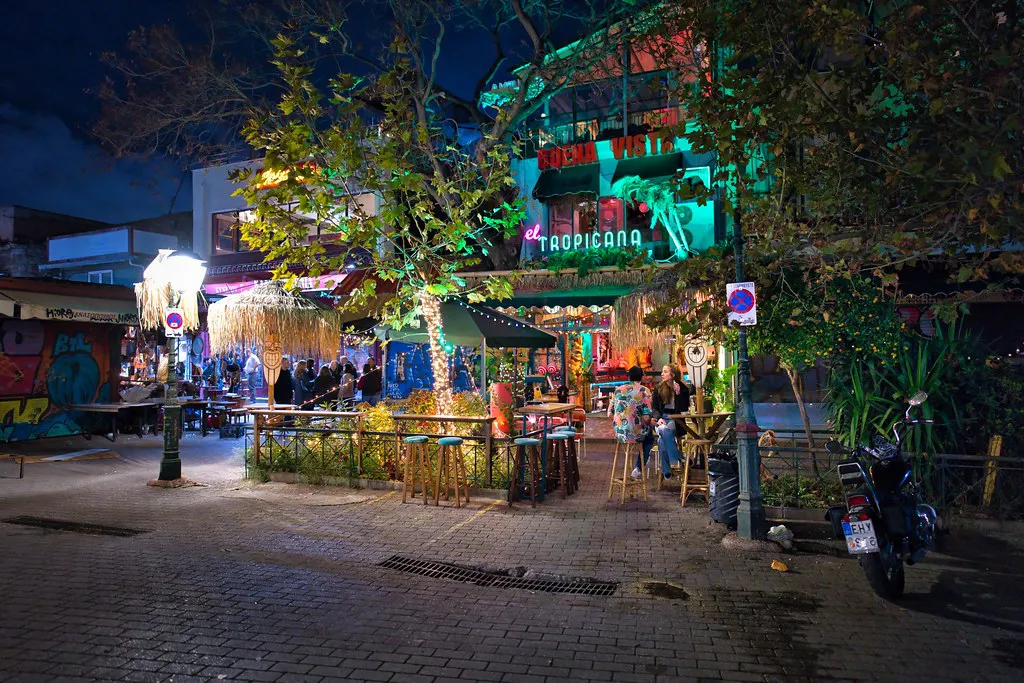
Dress codes shift by district. Gazi, Psyrri, and Keramikos are forgiving of sneakers and a t-shirt. Kolonaki cocktail bars, Syntagma-area lounges, and Riviera beach clubs like Island or Bolivar enforce smart-casual at the door. Men in shorts or flip-flops will be turned away at any venue charging more than 15 EUR entry, and women in athletic wear will get a similar look from the hostess.
Transport is the other trap. The Athens Metro shuts around 00:15 Sunday to Thursday and roughly 02:00 Friday and Saturday, which means you cannot rely on it to get home. Beat taxis and Uber both operate legally; a cross-city ride after 01:00 typically runs 8 to 14 EUR. Avoid unmetered yellow cabs that idle outside tourist clubs, and never accept a "flat fare" to the Riviera without agreeing on a number beforehand.
Winter vs Summer Athens Clubs: Don't Walk to a Closed Door
This is the detail that trips up almost every first-time visitor, and no guide makes it clear enough. Athens operates two parallel nightlife calendars. From roughly mid-October through mid-May, the scene lives inside the city, anchored by Gazi, Psyrri, Monastiraki, and Syntagma. From late May through September, a huge share of the city's flagship clubs physically relocate to the Athens Riviera coast, and their winter addresses simply go dark.
Lohan, Vinilio, and several of the Gazi A-list venues all run this dual-address system. Vinilio, for example, lives on Triptolemou Street in Gazi in winter and migrates to Varkiza Beach for summer; if you show up at the Gazi address in July you will find a locked door. Lohan similarly shifts its main party to its coastal summer outpost. Island, Manko, and Bolivar only open their full operation from late May onward, so in March they will appear on Google Maps but will not be running a club night.
My rule of thumb for 2026: if you are visiting between June 15 and September 15, plan at least one Riviera night and expect Gazi to be quieter. If you are visiting between November and April, stay in the city and skip the Riviera entirely. Always check the venue's Instagram story from the previous week before committing to a taxi ride, because opening dates float by two or three weeks each year based on weather.
Gazi: The Industrial Heart of Athens Clubbing
Gazi sits just west of the Kerameikos archaeological site, built around the old gasworks that now house the Technopolis cultural complex. It is the highest-density clubbing district in the best neighborhoods in Athens for nightlife, with converted warehouses holding 400 to 1,200 people each. The crowd skews 22 to 35, mixes tourists with locals, and leans toward commercial house, R&B, and mainstream EDM.
Lohan Nightclub is the anchor. Owned by the actress of the same name, it is a vast industrial room with aggressive lighting, bottle-service tables, and a strict door that keeps the line moving slowly on Saturdays. Entry runs 18 to 32 EUR including one drink, doors open at 00:00, and the peak hour is 02:30. Book a table in advance if your group is four or more; walk-ins after 01:00 frequently get waved past the bar to the dance floor without cover on slower nights. Best for mainstream clubbing and celebrity-spotting.
Gazi is also the LGBTQ+ nerve center of Athens. Sodade2 on Triptolemou Street has been the community's cornerstone club for more than two decades, running a two-room format (pop out front, trance and techno in back) and staying friendly to straight allies. Bequeer, a newer Gazi addition, programs some of the city's most ambitious drag nights. Both welcome visitors of any orientation and cost 10 to 15 EUR to enter.
Monastiraki: Rooftop Views and Underground Beats
Monastiraki is the rooftop capital of Athens, full stop. Every hotel and tall building within 400 meters of the metro station seems to host a bar on its top floor, and the lit-up Acropolis is always in frame. For a first-night-in-Athens drink, this is the right district.
A for Athens is the most famous terrace, open to non-guests and positioned for a direct Parthenon view. Cocktails run 12 to 16 EUR and the terrace stays open until 03:00. Arrive 30 minutes before sunset to claim a railing seat; the Α for Athens door staff will turn away groups of more than four without a reservation after 21:00 on weekends. Best for views and first-night drinks.
For underground music, Six D.O.G.S sits two blocks from the Monastiraki metro in a gravel courtyard with hammocks and trees. The basement club programs serious techno and house on a crisp Funktion-One-style sound system, with covers between 8 and 22 EUR depending on the lineup. TAF (The Art Foundation) next door pairs art installations with a courtyard bar, no cover, open until 03:00 daily. Both are best for the 25-to-40 alternative crowd who want music over spectacle.
Psyrri: Bohemian Bars and Live Music Stages
Psyrri is the neighborhood I send first-timers who want to bar-hop rather than commit to one club. The streets around Iroon Square are dense with small bars, live-music mezze tavernas, and late-night courtyards. Expect to pay one drink at each stop (6 to 10 EUR) and to cover four or five venues across a night.
Juan Rodriguez Bar stages rum-forward cocktails under painted wooden walls; Dos Gardenias channels a Caribbean gastronomic vibe with hand-painted tiles. To Lokali hides a courtyard under plane trees that feels like a Cycladic island. None charge cover. For actual stages, walk Aisxylou Street where small venues program rebetiko and rock live sets nightly around 22:00.
Psyrri is also the home of Backdoor, a small LGBTQ+-friendly cocktail bar that keeps serving until 04:00 and delivers skilled mixology without the Gazi volume. If you want one late-night cocktail before heading home, this is where locals go.
Plaka: The Romantic Evening Scene
Plaka is a tourist trap by day and a genuinely lovely district by night. The souvenir shops close around 22:00, the street-level crowds thin, and the narrow lanes under the Acropolis fill with the sound of clinking glasses and Greek guitar. Lyssiou, Mnisikelous, and Kydathineon Streets are the stretches to wander.
Brettos, operating since 1909 on Kydathineon, is the oldest distillery in Athens and an essential stop. The back wall of colored liqueur bottles is the most photographed bar in Greece, and a tasting flight of house Ouzo, Mastiha, and Kitron runs 10 to 14 EUR. Open daily until midnight, with no cover. Best for an early-evening spirits sampler before moving on to livelier districts.
Yiasemi on the steps leading up to Anafiotika pairs small tables with cushions and Acropolis glimpses. Klepsidra tucks into a courtyard with wooden tables and a taverna-meets-bar menu. Both stay relaxed until around 01:00 and attract couples rather than party groups. Plaka is where you eat mezze and drink wine slowly, not where you dance.
Koukaki: The New Favorite for Local Cocktail Bars
Koukaki is the neighborhood that arrived. Ten years ago it was a sleepy residential stretch south of the Acropolis Museum; today it holds the strongest concentration of independent cocktail bars in the city, all within a 500-meter radius of the Syngrou-Fix metro station. It is quieter than Gazi, cheaper than Kolonaki, and far more interesting than Monastiraki after midnight.
Tiki Bar Athens turns a small room into a 1950s Polynesian fever dream with rum-forward cocktails in the 10 to 14 EUR range. The Tiki Bar fills up fast on Friday nights; arrive before 23:00 or plan to stand. Feelin' Good on Georgaki Olympiou is an American jazz-and-blues homage with nightly live music and a short food menu. Best for cocktail-focused nights without the club commitment.
Paleo Wine Store, though technically in nearby Piraeus, belongs in this cluster. Owner Giannis Kaimenakis curates 200 Mediterranean labels with a rotating by-the-glass list spanning Italy, Spain, France, and Greece. Glasses start at 7 EUR, plates at 11 EUR. This is where sommeliers drink on their night off, and the crowd is 90% local. Best for wine-first evenings rather than party stops.
Tavernas and Live Music: Bouzoukia and Rebetiko Explained
The most culturally specific Athens night is a bouzoukia evening, and it is nothing like a club. A bouzoukia is a large venue (500 to 2,000 seats) built around a raised stage where a rotating cast of Greek pop singers perform live with a bouzouki orchestra from roughly 00:30 until 05:00. Guests do not stand and dance in front of the stage; they sit at reserved tables, drink whiskey, and occasionally throw carnations at favorite performers.
This is where tourists get blindsided by the bill. The standard entry model is a bottle of whiskey per four guests, which runs 160 to 280 EUR for a mid-tier brand and climbs to 450 EUR for premium labels. A single person buying per-drink pays roughly 18 to 25 EUR per whiskey. The famous "plate-breaking" tradition is functionally extinct due to 1970s-era laws; what replaced it is flower-throwing, where you buy trays of carnations (around 5 to 10 EUR per tray) from the venue and toss them onto the stage. It is considered tacky to bring your own flowers.
For a smaller and far cheaper introduction, rebetiko tavernas are the right entry point. Rebetiko is the blues of Athens — a 1920s urban folk genre born in refugee neighborhoods — and small venues in Plaka, Psyrri, and Exarcheia program live trios nightly. Try places along Aisxylou Street or ask a taxi driver for a "rebetadiko." Cover is typically 8 to 15 EUR including a drink, sets run 22:00 to 02:00, and you can pair it with any of the best bars in Athens afterward. Best for travelers who want Greek cultural depth on a reasonable budget.
The Athens Riviera: Summer Beach Clubs and Bolivar
From late May onward, the serious Athens nightlife lives on the coast. The Riviera is a 30-kilometer strip of beach clubs stretching from Faliro through Alimos, Glyfada, Voula, and Varkiza, ending at Cape Sounion. Think Ibiza with Greek staff, lower prices, and better food.
Bolivar Beach Bar on Alimos Beach is the easiest to reach and the most democratic in pricing. Tropical decor, international DJ bookings, full-day operation from 10:00 until sunrise during summer, and entry between 12 and 25 EUR depending on the headliner. The logistical key is the T6 tram from Syntagma Square to the Edem or Alimos stop (15-minute ride, 1.20 EUR, runs until 01:00). After 01:00 your only option back to the city center is a taxi, which costs 12 to 18 EUR. Plan for either an early night home by tram or committing to stay until 05:00 when the tram restarts. Best for affordable summer clubbing without a rental car.
Island Club and Restaurant in Varkiza is the pinnacle of Riviera glamour, perched on a cliff over the Saronic Gulf, with cocktail prices starting at 18 EUR and table minimums of 400 to 1,500 EUR. Manko at the One and Only Aesthesis hotel in Glyfada delivers a slicker Peruvian-Greek lounge with Sunset Sunday DJ sets. Both sit a 35- to 45-minute taxi ride from central Athens (run 35 to 50 EUR each way); there is no practical public transit option for either.
Alexander's Cigar Lounge at Hotel Grande Bretagne
If the thought of a warehouse at 04:00 sounds closer to hell than heaven, this is where you go. Alexander's Cigar Lounge occupies the first floor of the Hotel Grande Bretagne on Syntagma Square, behind dark wood and a marble bar, named for its 18th-century tapestry of Alexander the Great. It is the most sophisticated drinking room in Athens.
The dress code is smart (jacket preferred, collared shirt required for men, no sneakers or shorts). The bar holds one of the deepest rare whiskey collections in Greece, with tasting flights of single-malt Scotch starting around 35 EUR and premium pours climbing past 90 EUR. The adjacent humidor stocks Cuban cigars from 25 to 120 EUR each, and the lounge has designated smoking zones. Reservations are not always required but are strongly recommended on weekends and essential during Athens Epidaurus Festival season (June to August).
Come here after dinner, not after a club. A typical evening is two hours with one cocktail (18 to 28 EUR) and quiet conversation; the lounge closes at 02:00. Best for couples, business travelers, and anyone who wants Athens nightlife without a sound system.
Gazi vs Psyrri vs Kolonaki: Which District Is for You?
These three districts define the three core modes of an Athens night. Pick the one that matches your mood and build your evening from there.
- Gazi — Large-scale clubs, commercial house and R&B, late starts (peak 02:30), entry 15 to 32 EUR plus drinks at 10 to 14 EUR. Casual dress. Best for groups who want one big dance floor and a memorable headline venue.
- Psyrri — Small bars, live-music tavernas, bohemian courtyards, no cover at most venues, drinks at 6 to 10 EUR. Very casual dress. Best for bar-hoppers, couples, and solo travelers who want conversation and movement across four or five spots.
- Kolonaki — Upscale cocktail lounges, wine bars, fashion-crowd spots, smart-casual dress enforced, cocktails 14 to 22 EUR. Lower volume, earlier peak (23:30 to 01:30). Best for date nights, business visitors, and anyone over 35 who wants quality over BPM.
If you only have one night, I send most first-timers to Psyrri. If you have two, add Gazi on Saturday for a proper club experience. Three or more nights, rotate through Kolonaki for a polished cocktail evening.
Greek Spirits Guide: Everything You Need to Know About Ouzo
Drinking in Athens is a marathon, and knowing what to order matters more than ordering more. Ouzo is the anise-flavored national spirit, served in a small glass on ice with a separate bottle of cold water. Add the water yourself and watch the liquid turn milky white (the "louche" effect); it is meant to be sipped slowly alongside food, never shot. Ordering Ouzo at a high-BPM club will mark you as a tourist; it is a taverna drink.
Tsipouro is Ouzo's earthier cousin: a grape-based pomace spirit from northern Greece, usually served without anise and drunk neat or with one ice cube. It pairs with mezze and is the right choice at a rebetiko taverna. Mastiha is the one to know — a resinous liqueur from the island of Chios, served chilled as a digestif or used as a modern cocktail base. Many Koukaki cocktail bars feature Mastiha in their signature drinks, and the best rooftop bars in Athens often use it in sundowners.
Etiquette differs by setting. In a taverna or bouzoukia, never order a cocktail; stick to Ouzo, Tsipouro, beer, or wine. In a club or cocktail bar, never order Ouzo neat; order a Mastiha-based cocktail, a Greek gin (Grace or Votano are excellent), or simply a vodka-soda. Locals also drink Retsina (pine-resin wine) and Assyrtiko (Santorini white) with food, not after. A bottle of house wine at a taverna runs 14 to 22 EUR; a cocktail at a Koukaki bar runs 10 to 14 EUR.
Late-Night Street Food: The Essential Post-Club Ritual
No Athens night finishes without souvlaki. Around Monastiraki Square, Kostas on Pentelis Street runs the oldest stand-up souvlaki counter in the city, open until 02:00 with pork or chicken wraps at 3 to 4 EUR. Thanasis on Mitropoleos Square stays open until 03:00 on weekends and specializes in kebab wraps. Both are within 400 meters of the main Gazi and Psyrri club zones.
For a deeper Athenian recovery ritual, head to the Central Market (Varvakios Agora) for Patsas at Papandreou or Diporto. Patsas is a tripe-and-trotter soup seasoned with vinegar and garlic, served from 04:00 until noon. It is the legendary hangover cure that truck drivers, market workers, and clubbers share at dawn. Expect 6 to 9 EUR a bowl, a counter seat on a worn stool, and zero English menus. The smell is intense on first encounter; the broth is surprisingly clean and restorative.
If tripe is not your thing, bakeries across Psyrri and Koukaki open at 05:00 with fresh spanakopita, tyropita, and bougatsa. A warm cheese pie at a neighborhood bakery for 2 EUR as the sky turns pink is, in my view, the correct way to end any Athens night.
Planning Your Trip: 72 Hours in Athens and Day Trips
Three days is the sweet spot for a nightlife-focused Athens visit. Day one, sleep in after the flight, see the Acropolis in late afternoon, have a Plaka taverna dinner, and end with cocktails at A for Athens or Brettos. Day two, hit Psyrri for a bar-hopping evening starting at 21:00 and finishing with souvlaki at 02:30. Day three, go big: an early Gazi dinner, a Koukaki cocktail stop, then Lohan or Sodade2 until sunrise.
If you extend to four or five nights in summer, build in a Riviera night. Take the T6 tram to Bolivar on a Friday evening, swim at Alimos Beach during the day, transition into the club crowd by midnight, and taxi back at 03:00. Budget 50 to 70 EUR per person for the day including transport, drinks, and cover.
For a day-trip contrast, the Temple of Poseidon at Cape Sounion (90 minutes south by bus) makes a spectacular sunset destination you can combine with dinner at a Riviera beach restaurant on the drive back. Aegina Island, a 40-minute hydrofoil from Piraeus, offers a quieter evening with local tavernas and zero clubbing. For broader planning inspiration, the wider Europe nightlife guides map how Athens compares to Thessaloniki and Mykonos for multi-city Greek itineraries.
Is the Athens Nightlife Scene Worth Visiting?
Athens is one of the three best nightlife capitals in Europe, alongside Berlin and Madrid, and arguably the best-value of the three. A full Gazi club night including cover, three drinks, a taxi home, and post-club souvlaki costs around 60 EUR; the equivalent evening in Berlin runs 80 to 100 EUR and in London closer to 150 EUR. The music ceiling is also genuinely high, with international techno and house DJs regularly playing Six D.O.G.S, Bolivar, and Romantso.
Safety in the main nightlife zones is good. Gazi, Psyrri, Monastiraki, Plaka, and Koukaki are all well-lit and busy with pedestrians until 05:00. Standard urban precautions apply: watch pockets in crowded metro stations, stick to marked Beat or Uber cars for late returns, and avoid Omonia Square late at night. Solo women travelers report feeling comfortable in all five core districts.
The single biggest mistake I see first-timers make is overbooking. Two solid nights out in Athens will exhaust almost anyone; four will wreck you for a week. Pick your nights deliberately, pace the drinks, eat on the way in and the way out, and let the city's 02:30 peak time dictate your schedule rather than fighting it. The reward is the kind of night you will still be telling stories about five years later.
Frequently Asked Questions
What time do clubs in Athens usually open and close?
Most major clubs in Athens open around midnight but do not get busy until 2 AM. They typically stay open until 6 AM or 7 AM, especially on Friday and Saturday nights. Some smaller bars in Psyrri may close earlier around 3 AM.
Is there a dress code for Athens nightclubs?
Dress codes vary by neighborhood. Gazi and Psyrri are casual, but high-end clubs in Kolonaki and the Athens Riviera often require smart-casual attire. Men should avoid sneakers and shorts if heading to upscale venues like Lohan or Island.
What is a Bouzouki club?
A Bouzouki club is a traditional Greek venue featuring live folk music and singing. Unlike standard clubs, guests usually sit at tables and may throw flowers at the performers. These nights are expensive and often last until dawn.
Athens remains one of the most vibrant nightlife capitals in the world, offering a mix of ancient charm and modern energy. Whether you find yourself dancing on a beach in Alimos or sipping Ouzo in a Plaka alley, the city's spirit is infectious. By following the local rhythm and starting your night late, you will discover the true heart of the Greek capital.
Remember to pace yourself and embrace the post-club street food culture that makes the experience complete. Athens is not just a city of ruins; it is a living, breathing celebration of life that never seems to sleep.


